We have been living through unprecedented times with little historical comparison and uncharted waters lie ahead. As the world continues with social distancing, lockdowns, and travel disruptions to fend off COVID-19, we are beginning to see the extent to which every industry is effected. The resulting emotional, psychological, and existential challenges faced by the American workforce in-particular have been especially troubling.
As recently unemployed workers run out of money and options , gig-economy stalwarts like Uber, Lyft, Doordash, and others believe they can offer an alternative solution to traditional jobs and help boost the US economy. On the surface this appears to be good news. However, the story about the gig-economy and whether it will continue operating with certain lucrative yet controversial practices is still up in the air.
Trade unionism and unskilled labor
The origins of the labor movement in the United States stretches back to this countries inception. Trade unionism surfaced in the mid-19th century as a response to disturbing (and even life-threatening) working conditions and insufficient compensation as industrialization swept the world, but it was primarily a movement by and for skilled workers. This changed in the 20th century as labor groups grew from local to national organizations and became increasingly powerful as they successfully negotiated workers compensation and workplace safety standards. However, at its peak only a fraction of the workforce (about 1/3) were unionized.
As the digital revolution inspires the same potential for abuse and a new call for labor rights, much like the industrial revolution did in the 19th and 20th centuries, new labor unions have appeared to help provide gig workers with enough leverage and collective bargaining power to demand reasonable wages, health insurance, equipment stipends, and retirement plans. For example, Rideshare Drivers United and Gig Workers Rising are two of the organizations that represent a new model for unions representing full-time drivers in the 21st century. And in places like Norway and Japan, food delivery couriers are forming the first unions for delivery app workers as of fall 2019.
A tale of two transportation logistics companies
The two most widely known Transportation Network Companies (TNC’s), Uber and Lyft, offer similar services but have different origin stories, trajectories, regional operations, and brands. Both companies continue to benefit from each others successes and missteps, and sometimes join together to coordinate and ward off attacks by state and federal regulators, and legislators.
Uber launched its service to the public in San Francisco in 2011 when it began offering an app-based premium black car ride hailing service. Lyft, which launched its ride-sharing service in 2012 had a much different approach. They began by promoting a more casual service which targeted riders looking for a friendlier experience, and drivers looking to use their own vehicles to earn some extra income in their spare time. It was so casual in fact that between 2012 and 2014 drivers were given massive bright pink fur mustaches to place on the front of their cars as a way to identify themselves clearly as Lyft drivers. Riders were also encouraged to sit in the front seat next to the driver, and to give drivers a “fist-bump” as they entered the car.
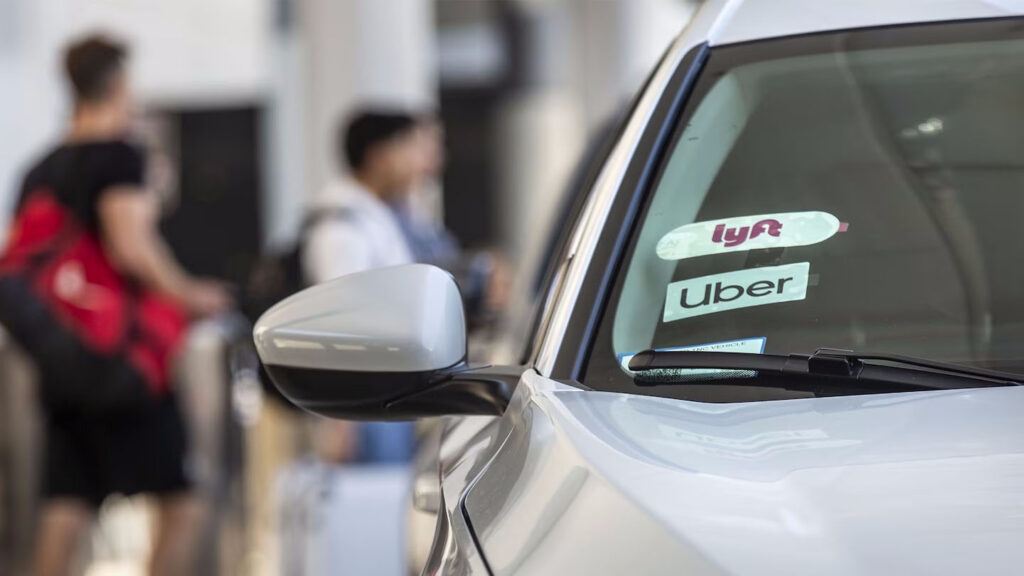
In July of 2012 Uber added a low cost ride-hailing service called UberX which put Uber and Lyft in direct competition. By 2016 the gig-economy had finally arrived, but it wasn’t immediately clear if it offered the same value that we once thought it did. In the ride-sharing space these companies had become homogenous and were becoming more similar every day when it came to long-term strategy and growth in ride-sharing. However, the essential problem with their business models were (and still are) that growth depends on disenfranchising its workforce by offering them sub-optimal wages and few or no benefits while quietly promoting a total transition of that workforce to one that is automated. Uber has spent billions developing autonomous driving technology within their Uber ATG (Advanced Technologies Group) subsidiary which they recently sold to Aurora, largely because self-driving technology is simply not reliable or viable en masse in the near-term.
What makes the gig economy different?
Gig companies promote benefits like additional time flexibility for the worker, saying that gig workers can work as much or as little as they choose. But with this added freedom comes several significant downsides, the most pertinent being that driving for Uber or Lyft is the lowest paid work in America next to working at a fast food restaurant. Uber and Lyft drivers make on average nine dollars an hour and this does not yet account for gas, insurance, car repairs, and other expenses that are the drivers responsibility. One recent study found that 20% of app-based drivers may earn zero dollars after expenses.
The gig economy only functions when labor is cheap and essentially redistributes capital back to the business that would otherwise be used to compensate and protect drivers. These funds are then used for operational expenses with the promise of ultimately creating growth and compensating investors, shareholders, and executives. This business structure only works if profitability and significant growth continue to be viable, and in the case of Uber and Lyft profitability is directly linked to cheap labor or a fully automated fleet.
Some pivotal moments for Ride-sharing
Gig companies have seen their share of scandals over the last few years. Here are a few pivotal moments in the last decade of this model in action that are worth noting:
- Jan 2017 — The #deleteuber movement which was responding to Uber’s mishandling of its response to the Muslim no-fly ban instituted by President Trump. Lyft benefited from the anger that Uber created as a result of this tactical failure and significantly increased its US market share and its brand equity.
- Feb 2017 — The explosive revelations by a former Uber employee of systemic sexual harassment in its corporate offices. This is largely credited with changing the sexual harassment policy landscape throughout corporate America.
- Aug 2019 — After several years of benefitting from #deleteuber, Lyft is criticized for not doing more to make their customers feel safe, and riding on older successes.
- Sept 2019—California measure AB5 is passed by the California legislature and passed into law.
- Dec 2019 — An Uber study performed in the US market suggested that 3,000 reports of sexual assault occurred in its U.S. rides in 2019, and 6,000 reports had previously been filed between 2017 and 2018.
- May 2020 — Both Uber and Lyft are sued by the state of California for denying drivers benefits.
- Nov 2020—California voters pass Proposition 22.
Who are Uber & Lyft drivers?
Those who drive for these companies full time are often living in low-income urban areas and predominantly minorities. Now with the advent of COVID-19 these workers have lost some (or all) of their revenue due to almost non-existent demand, and even if they did drive now they would risk contracting and then spreading the virus.
Over the last decade gig-companies have declined to provide full-time gig-workers with paid sick leave, health care, car insurance, assistance with car repairs, and other essentials for workers of this type — basics which might be considered required for workers who make far less than minimum wage. The Coronavirus has further emphasized the need for better treatment of workers, for their well-being and to help ensure public health and safety.
Working conditions, compensation, and benefits
- Working conditions. Both Uber and Lyft drivers are required to stop working for 6 hours after 12 hours of driving. The Federal Motor Carrier Safety Administration (FMCSA) states that drivers may drive no more than a maximum of 10 hours after 8 consecutive hours off duty for passenger carrying vehicles.
- Low wages. Uber and Lyft drivers make on average nine dollars an hour and is considered to be the lowest paid work in America next to working at a fast food restaurant.
- No health insurance. As is often the case with contractors, even full-time Uber or Lyft drivers are responsible for their own health insurance.
- No paid sick leave. When drivers don’t have paid sick leave and they can’t afford to be sick, and they run the risk of having to work while sick and then infecting their passengers. Passenger safety is not prioritized in this model.
- No stipends for car maintenance, repairs, parking, and gas.
- No stipends for auto or personal liability insurance.
- Self-Employment Tax: Drivers are responsible for self-employment tax (SE tax) is a tax for individuals who are self-employed and accounts for Social Security and Medicaid.
- No retirement benefits.
A recent UC Santa Cruz Institute for Social Transformation (ISC) study from May 5, 2020 shows that in the city where the two companies are headquartered (San Francisco, CA):
- 78% of app-based drivers are people of color
- 56% are immigrants
- 71% of these app workers work 30 hours a week
- 50% work over 40 hours / wk
- 52% of ride-hailing drivers said they have been working more than 2 years for their app-based company
- 46% support others with their earnings
- 33% support children
- 32% reported sometimes or often sleeping in their cars before or after performing app-work
- 27% would maybe or likely go to work if they woke up with a fever
- 20% of app-based drivers may earn zero dollars after expenses
A notable quote from this study concludes: “Even before the virus, 70% of ride-hailing drivers say they experienced a decline in earnings since they began work on the apps. Of those experiencing a decline, most of them attributed it to company practices, including a decrease in base pay as well as a decrease in incentives and bonuses.”
Shifting business models as the field narrows
In 2018 Uber bought micro-mobility e-bike and e-scooter sharing company Jump and in May 2020 they merged its business with Lime after leading an investment round for the latter. Uber and Lyft are attempting to diversify their businesses into other adjacent markets.
California recently passed AB5 — a piece of legislation meant to address these business practices, and the state has now ordered Uber and Lyft to reclassify their drivers as employees. So far, these ride-sharing companies have refused the order and are in the midst of a significant existential legal battle. In 2019 ride-sharing companies spent over $100 million dollars to fight this AB5 legislation. It is such a threat to the future viability of these companies that they have decided to bring the issue to the polls and let the people decide the outcome.
A new initiative qualified for the ballot in California last November called the “Protect App-Based Drivers and Services Act” or Prop 22 (sponsored by Uber, Lyft, and Door Dash) and endorsed by the Republican Party of California. These companies spent $200 million to promote their initiative and it passed with 58% of California voters approving the measure. It determined that ride-sharing companies did not have to abide by AB5 and they offered certain protections like a minimum wage guarantee and health stipends in return, both of which were criticized for misrepresenting what drivers would actually receive.
Where do we go from here?
One could draw the conclusion that these business models rely on primitive models of engagement with their primary workforce and perhaps even a lack of understanding (or empathy) for the engine that drives their businesses growth. In this respect profitability is achieved without acknowledging the contributions of their workers, and to a degree, exploiting them. It is likely that this imbalance will fuel new competition, meaning new startups with a means to attract drivers and delivery people seeking more equitable cuts of their hourly wages, or perhaps new business models will arise in the future. One such model is Nomad Rides (backed by Y-Combinator) which is based on the premise of giving drivers their full fare and sourcing revenue through other means.
When workers are valued, respected, and rewarded for solid work they become every companies greatest single asset. Gig companies have established a class system within their organizations that offer highly-paid corporate jobs with full benefits to those who are skilled and educated, and low-paying limited contract work to unskilled laborers. One can easily see an imbalance here, and deduce that in the future such experiments in organizational structures and business models will have to embrace the notion that workers are important regardless of their class or skill-level, and that they must demonstrate an understanding of this or face a very divided internal culture and limited opportunities for future growth, especially internationally.
Sources and references in this article:
Legality of ridesharing companies by jurisdiction [Wikipedia]
https://en.wikipedia.org/wiki/Legality_of_ridesharing_companies_by_jurisdiction
A third of Americans now show signs of clinical anxiety or depression, Census Bureau finds amid coronavirus pandemic [WaPo]
https://www.washingtonpost.com/health/2020/05/26/americans-with-depression-anxiety-pandemic/
How Much Do Uber and Lyft Drivers Make? [The Street]
https://www.thestreet.com/personal-finance/education/how-much-do-uber-lyft-drivers-make-14804869
Uber, Lyft and DoorDash bring their battle against AB5 to November ballot [SF Examiner]
https://www.sfexaminer.com/news/uber-lyft-and-doordash-bring-their-battle-against-ab5-to-november-ballot/
What you need to know about #deleteuber [NYTimes]
https://www.nytimes.com/2017/01/31/business/delete-uber.html
Federal Motor Carrier Safety Administration [FMCSA]
https://www.fmcsa.dot.gov/regulations/hours-service/summary-hours-service-regulations
Uber and Lyft used sneaky tactics to avoid making drivers employees in California, voters say. Now, they’re going national. (WaPo)
https://www.washingtonpost.com/technology/2020/11/17/uber-lyft-prop22-misinformation/